

Finance chiefs rethink revenue and reserves to sustain missions
The 2026 CFOs of the Year share strategic decisions behind diversifying revenue and investments, and automating operations for growth.
- September 11, 2026 |
-
 Susan Milligan
In a tough financial era for nonprofits, chief financial officers have had to take a hard look at how they raise and spend their organizations’ money. The traditional methods of raising revenue — membership dues, conferences and subscriptions — aren’t enough anymore. And in some cases, accounting and information systems need to be updated to save time and money.
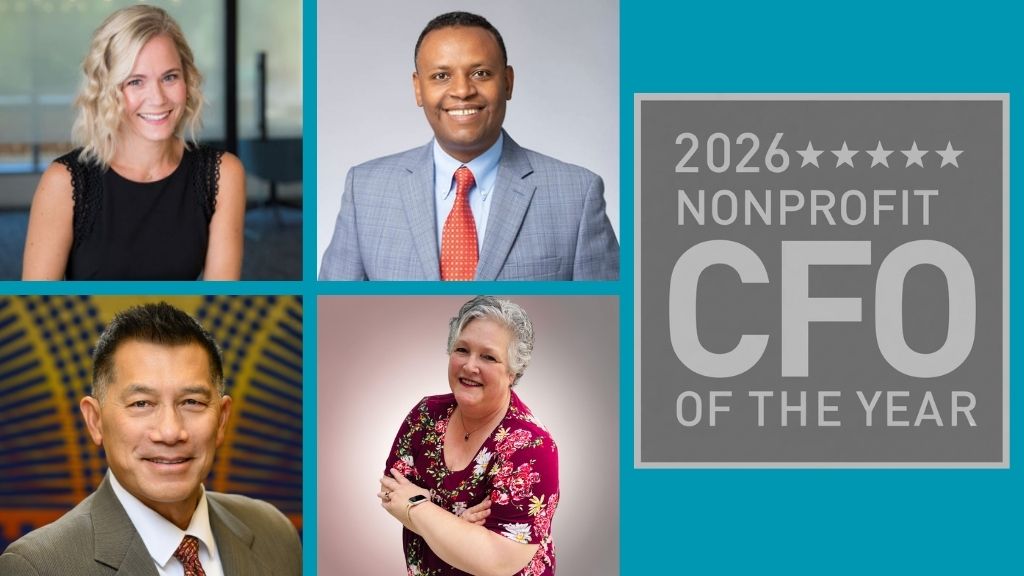
The 2026 Nonprofit CFOs of the Year — Marta Sokol, Zerihun Haile-Selassie, Ray Oen and Ellen Hobby — have all tackled financial challenges at their organizations and found innovative ways to bring in money while streamlining office processes to save cash. They are helping their associations stay solvent and remain true to their missions.
Marta Sokol
Midsize Association CFO of the Year
For Marta Sokol, CFO for the $16 million-revenue Wireless Infrastructure Association (WIA), the COVID-19 pandemic was the worst of times for the association. It also turned out to be the best.
The public health emergency hit associations hard and WIA was feeling the fiscal pressure. The annual Connect (X) conference had been a core moneymaker, making $2.2 million in 2019. Having to cancel the meeting and shift to a smaller, virtual event in 2020 was a huge blow to finances and morale.
But Sokol learned that crisis can create opportunities for change and those changes can strengthen the organization and its finances for the long term.
One of Sokol’s first responsibilities when she arrived at WIA in 2015 (then as vice president of finance and administration) was to manage an office move when the association’s lease ended. The old office — and subsequently, its culture — were “pretty closed off,” Sokol said, with closed doors and not much spontaneous interaction.
At the new office, glass replaced walls and closed doors. A kitchen was added so people could meet and eat together, which led to regular team lunches and employee events, creating a more collaborative culture.
When the pandemic hit in 2020, Sokol had to do some fancy financial footwork — natural for the competitive ballroom dancer who studied under renowned Polish dancer and choreographer Piotr Galiski. But she was also used to steep challenges. Born in Poznan, Poland, where she earned her master’s degree in finance and banking, Sokol left for the U.S. in 2004 with little more than a dream and determination. She learned English, became a U.S. citizen and received her MBA from George Mason University.
WIA’s annual conference remained an important revenue source, even after the pandemic. The association poured extra effort into the event, making it better and more popular than ever, Sokol said, resulting in $2.6 million in revenues in 2021 and jumping to $4.3 million this year.
Sokol knew, however, that businesses can’t rely on just one revenue source. WIA stepped up its workforce development and, for the first time, applied for grants and government contracts to profit from those services. In the middle of an economically devastating pandemic, WIA won a four-year, $5 million grant and a separate five-year, $11 million contract with the U.S. Department of Labor (DOL) to help build apprenticeship programs. That was followed by a $3.3 million contract with Ohio’s Broadband and 5G Sector Partnership, serving as the industry intermediary.
Those contracts have concluded, but WIA just started a new one this summer: a $30 million, four-year contract with DOL.
“We came out of the hardest year in our history more diversified than when we went into it,” Sokol said. “Instead of just protecting our show, we grew it. We built a whole new road of revenue lines alongside it.”
WIA’s operating budget was $7 million when Sokol started. It is $17 million today — and will grow because of the new contract, she said.
“I think everyone in my role — or any leadership role — should use disruption as a chance to modernize the organization,” Sokol said.
“The hard stress exposes the weaknesses, for sure. But it can also accelerate the changes.”
Zerihun Haile-Selassie
Large Association CFO of the Year
Like many nonprofits, the $27 million-revenue Endocrine Society was facing powerful financial headwinds when Zerihun Haile-Selassie became CFO of the 18,000-member organization in 2022. The COVID-19 pandemic hurt a wide swath of businesses and groups and the Endocrine Society was no exception. Conferences were not bringing in the big bucks as they once had, as people realized they could network virtually instead of paying to travel and attend a meeting. The entire nonprofit scientific community was taking a hit with publishing and print subscriptions, since so much research was becoming available online, he noted.
The Endocrine Society did, however, have a healthy reserve (now about $70 million). With no background of endocrinology but extensive education in finance and accounting, Haile-Selassie came up with an out-of-the-box idea: Instead of sequestering the reserve as a kind of rainy-day fund, why not invest some of it in an entirely different kind of company?
It wouldn’t matter if the company had the same mission as the Endocrine Society. What the organization needed was revenue. If there was one thing he’d learned after two decades in the nonprofit space, Haile-Selassie said, it was: “No money, no mission. No mission, no money.”
He and others at the Society convinced the board to let leadership use some of the reserves for a carefully chosen investment that would produce reliable revenue down the road. The board agreed to let them spend up to $20 million on another business venture, be it an acquisition, joint venture or subsidiary.
After conducting excruciating due diligence on about 30 companies, the Society invested in Matchbox Virtual Media (now known as Matchbox). In 2023, they pursued a joint venture with Matchbox, a Canadian company that organizes virtual demo days, which its website describes as “structured online events hosted by professional and trade associations, designed to simplify the vendor discovery process.”
Haile-Selassie wouldn’t reveal the precise investment but said it was “a fraction” of the $20 million the board allocated. The venture hasn’t produced financial returns yet, but Haile-Selassie said he expects it will. And he sees it as a path for other nonprofits to secure reliable funding in unreliable times.
Haile-Selassie said collecting money to operate your organization “doesn’t need to be membership or some sort of nonprofit activities. It can be a revenue-generating activity. We can invest in them, and get a better return than the traditional six to 10, 10 to 12 (percent) return.” An added bonus, Haile-Selassie said, is that the arrangement does not threaten the Endocrine Society’s nonprofit tax status.
“Traditional revenue sources (have been) impacted, so the nonprofit world has to reinvent and see things differently,” Haile-Selassie said. That means “changing the business model, making it sustainable growth for the Society — for the entire industry.”
It was a risk, but Haile-Selassie is used to taking risks. One of five children raised by a single mother (while he handled the family finances), Haile-Selassie left his home country of Ethiopia in 2003 with a finance degree but no English skills to make a life in the U.S. He earned a B.A. in accounting from Strayer University and then an M.S. in accounting and information systems from the University of Maryland Global Campus.
Haile-Selassie was CFO at Inteleos, a nonprofit that administers healthcare certifications and exams, before joining the Endocrine Society in 2022.
When Haile-Selassie started at the Endocrine Society, the deficit was around $2.8 million. Now it’s about $1.7 million — not yet a “win,” he concedes, since economic challenges are ongoing, but the groundwork has been set for long-term financial stability.
Ray Oen
Large Nonprofit CFO of the Year
Ray Oen says the Seattle area has a lot of relatives in need of rehabilitative care for substance use disorders — a capital-intensive, culturally sensitive mission for the $47 million-revenue Seattle Indian Health Board (SIHB).
By “relatives,” Oen, SIHB’s chief financial officer, means members of the Indigenous community. “We want to think about our patients and treat them in the way that we would want to treat our family or our relatives to be treated,” Oen said.
This summer, SIHB achieved an ambitious and complicated goal: Find, fund and financially sustain an in-patient substance use disorder center for a community disproportionately affected by addictions to opioids and other substances, all while honoring the traditions of the Native community. It achieved this by reopening the Thunderbird Treatment Center, which it had shuttered in 2020 because SIHB wanted a more modern facility.
“We have such a long-term vision for growth, and providing additional services, that is not typical with nonprofits and has not been typical with the nonprofits I worked for in the past,” said Oen. “The specific challenge for me here was really, how do I (execute on) this vision of pro-growth and think about the long-term financial sustainability of the organization as well as the specific projects?”
Before Oen — a Dartmouth MBA whose path to financial management includes being a pre-med student and a Navy submarine officer — arrived at SIHB in 2024, the nonprofit had already purchased a building on Vashon Island to turn into a rehab center. The $11 million purchase price came from the federal government’s Enhanced Federal Medical Assistance Percentages (eFMAP) program, part of the COVID-19 era American Rescue Plan. Renovating the facility that would become Thunderbird Treatment Center East Wing cost another $17.8 million, Oen said.
Oen’s task was finding a way to make a public rehab center — a facility that typically has money stresses — financially stable while remaining accessible and culturally appropriate for the community.
Oen came up with two methods to bring in more money to sustain the 94-bed facility: Set aside 15 private-pay VIP rooms for people (such as tribal council leaders) who want more privacy and discretion while they are undergoing the 45-day treatment program. Since the price will be higher than the Medicaid reimbursement for the other rooms, SIHB will be able to subsidize the rooms occupied by Medicaid or uninsured patients, helping to “maintain the financial sustainability of the facility going forward,” he said.
Another 15 rooms are being set aside for pregnant and birthing people, allowing those with kids up to five years old to be around their children while they recover.
Meanwhile, Oen accelerated the construction of a dental clinic on-site. The cost of the private-pay center (known as Thunderbird Treatment Center West Wing) and the clinic, which is expected to open in March 2027, totaled $12.4 million, bringing the cost of the entire project to $41.2 million.
SIHB gets its funding from government sources (federal, state, county and city) as well as foundation donations for specific projects like Thunderbird. But cash flow is still an issue, Oen said, as they wait for reimbursements while expending money on the new Thunderbird project.
So Oen edged the organization to focus more on its budget and expenses. Now, staff are more focused on getting complete insurance information from arrivals, making sure the proper institutions are billed for services.
For Oen, this role feels similar to being in the Navy: “You’re not there to serve yourself. You’re there to serve and work with your fellowship needs.”
Ellen Hobby
Midsize Nonprofit CFO of the Year
When Ellen Hobby took the job as COO of the $8.5 million-revenue League of Women Voters (LWV) in 2021, she found it easy to get behind the nonpartisan nonprofit’s mission of supporting democracy and voter empowerment.
The behind-the-scenes work of accepting donations, managing grant requests from state and local leagues and handling basic accounting, on the other hand, was a nightmare. Everything was done manually: the 80,000 individual receipts, the 15,000 yearly transactions for accounts payable, expense reports and reimbursement. Disbursing the 200 to 350 grants the central office gives out each year was done by hand, down to stuffing and stamping envelopes. The practice was consuming money and staff hours that Hobby wanted to use on mission work.
On top of that, the LWV’s finances needed attention. There was too little focus on fundraising, said Hobby, who is responsible for finance and accounting, IT and risk management. The ratio of spending on overhead versus core programs and services was too high. And there wasn’t a real-time system to assess finances and make spending decisions quickly.
Hobby made it her personal mission to take the 106-year-old League into the 21st century. She started by automating all the financial transactions and reporting, to help reduce errors. Grant applications moved online.
“It was literally taking several months to close the books” before automation, Hobby said. These changes have “saved thousands and thousands of dollars, and opportunity costs for people who were doing all these things manually.”
The next step was big-picture finances, including fundraising. Hobby set specific financial metrics, including a cash reserve ratio and a long-term investment ratio, improving the group’s standing with charity watchdogs.
The result? When Hobby arrived, the LWV was spending 48% of revenues on its core mission and projects — well below the 70% that Charity Navigator considers a minimum bar. Now it’s between 70% and 76%, Hobby said. And for the $10 million-revenue LWV Educational Fund, the 501(c)3 arm of the organization, the ratio is even higher — now between 85% and 91%.
When Hobby arrived, LWV had no rating on GuideStar, the nonprofit evaluator. “We’re at platinum now,” Hobby said.
Fundraising, previously, had been project-based: When a project ended, so did the funding. Hobby has shifted the approach to collecting multi-year, multimillion-dollar general operating commitments from private foundations. That has paid off, literally: The annual budget increased from $13 million when Hobby arrived to almost $31 million projected for 2028. Staff has gone from 34 to 70 in fiscal year 2027.
Long-term, Hobby is leading LWV through its “transformation journey,” with a DEI program to “make our organization look more like the population of the country” and to attract and retain members, who now number 70,000 in the League’s 750 to 800 local and state chapters.
Hobby also simplified the dues process, allowing people to join online and she helped create a database to help the League make data-driven decisions to retain members.
Hobby hadn’t expected to spend a career in nonprofits, where she has served for 30 years. Coming from a blue-collar family “who basically thought marriage and children should be my full-time job,” Hobby ended up working for a satellite communications company, where she developed a fascination with accounting.
It wasn’t easy — a pregnancy in college slowed her path and it took her a decade to get her degree and then her accounting certification. Nonprofits made her feel like she was serving the community, even as others urged her to just use her accounting degree to make the big bucks.
Now, several decades later, Hobby says she can’t imagine any other path.
“We need good people, and if anybody ever tells you this is not a career, it’s a complete lie,” she said. “You look back and you think: I did something along the way that really helped people.”