

When associations need to speak, lobbyists do the talking
Leading association lobbyist honorees share the thrill of advocating for an entire industry or profession on the Hill.
- December 15, 2025 |
-
 Susan Milligan
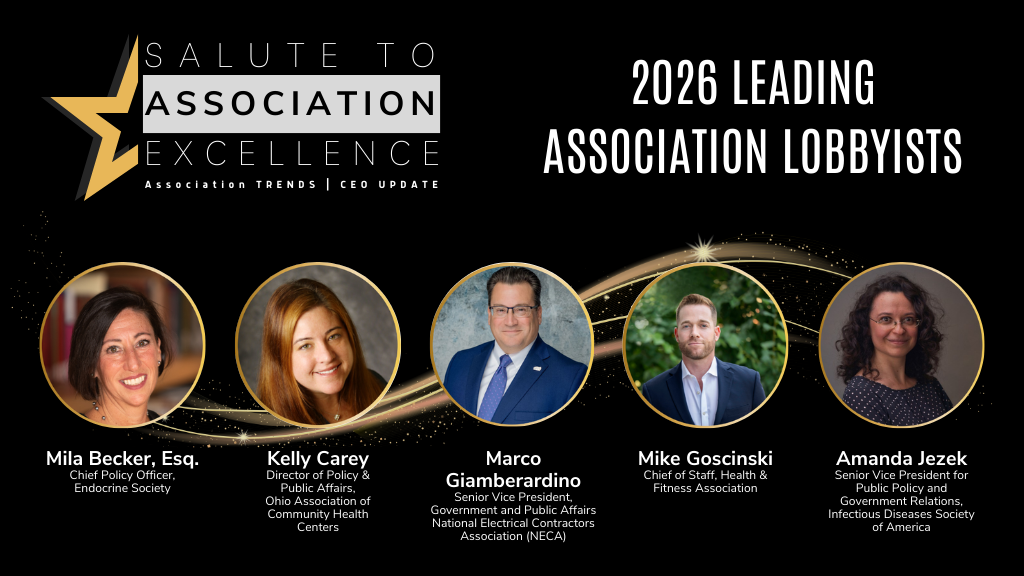
Associations provide a way for industries or public interests to speak with one voice. But someone needs to do the talking, and that’s where lobbyists come in. Without an informed advocate making their case, associations would not be able to convince lawmakers to shape good policy for their members. It takes skill, patience and meeting policymakers face-to-face to develop relationships of mutual trust.
The Salute to Association Excellence Leading Association Lobbyists do all those things. Honorees Mila Becker, Amanda Jezek, Mike Goscinski, Kelly Carey and Marco Giamberardino spoke to CEO Update about why they became lobbyists — and what sets them apart.
Staying on the radar
Lobbying for public issues seemed like a normal part of life for Mila Becker. Becker, chief policy officer for the Endocrine Society, grew up in the Washington area, where her mother was a public relations professional and her father lobbied for higher education.
“I thought everyone grew up and did this,” Becker says. “I was introduced to this world from the beginning. It’s in my blood.”
Working for associations was ideal for Becker, who sees nonprofits as a way to help lawmakers’ constituents. A graduate of Northwestern University and Georgetown University Law Center, Becker was a senior lobbyist at AARP and then spent a decade working for the American Society of Hematology. She joined the Endocrine Society staff in 2013. She explains to legislators what endocrinology is and why it’s so critical to people’s health. The body’s glands and hormones affect all kinds of health issues from mood disorders to diabetes, bone health and even some cancers.
When it comes to advocating for the society’s 18,000 members, the issues are broad as well: physician payments, women’s health and funding for the National Institutes of Health. She scored a victory this year when she lobbied to protect the Diabetes Prevention Program Outcomes Study (DPPOS), which looks at the impact of diabetes on overall health.
The program was initially a casualty of the Trump administration’s feud with Columbia University over pro-Palestinian protests. When the school’s federal funding was slashed, so was the study, which was being coordinated at Columbia. Working the contacts she had developed on the Hill, Becker and her team got lawmakers to pay attention. They raised the issue with Health and Human Services Secretary Robert F. Kennedy Jr. during a hearing, and he ended up restoring the program — a win for the Endocrine Society.
The secret to being a successful lobbyist? Showing up, Becker says. “You need to be there — not necessarily in an aggressive way, but on their radar and in their face.”
Sticking to the facts
Growing up, Amanda Jezek was inspired by her mother’s work, helping one patient at a time as a nurse. So she chose a vocation where she could help entire communities.
“I grew up in the ‘80s, and I remember her telling me about taking care of patients with AIDS, how angry she was that for too long the federal government wasn’t doing anything,” says Jezek. “I wanted to serve in some way. I wanted to help people … make good policy.”
As senior vice president for public policy and government relations at the Infectious Diseases Society of America (IDSA), Jezek has made a career out of advocating for public health. After a stint working for a member of Congress, Jezek worked for Mental Health America and the March of Dimes before joining IDSA in 2011. She fights for infectious disease research, access to life-saving vaccines and global health while representing IDSA’s 13,000 members.
Recently, Jezek and her colleagues have faced unusual challenges. They are advocating not just for access to vaccines but for the validity of the shots themselves.
“The fascinating thing about infectious diseases in particular is that there is always something new,” says Jezek, a Dartmouth College graduate. “I’ve been here through Ebola and COVID, and now what I would call the pandemic of misinformation. It’s every bit as deadly as an actual pathogen. If you had told me 20 years ago that this is what I would have to do right now, I’d have never believed you.”
In an unusually politicized atmosphere, Jezek approaches lawmakers not just as a public health advocate, but as a mother. She knows what it’s like to take her own children to be vaccinated (including chasing one of her kids through the CVS) and explaining to them that while no one likes to get a shot, a vaccine will help them avoid getting sicker later.
“It’s incredibly human to have questions about vaccines, medicines, anything we’re being told to put in our bodies,” Jezek says. “We should absolutely ask those questions, but I think it is the responsibility of anyone who claims to be an expert or leader in the space to respond to those questions accurately, honestly and without judgment.”
That’s the tactic Jezek employs on Capitol Hill — educating lawmakers and staff on the facts. Building on relationships she developed working on bipartisan issues, such as antimicrobial resistance and biomedical research, Jezek provides essential answers on vaccines: how they are studied, how their safety is ensured, and the dangers of making it harder for people to get vaccinated.
“In so many ways, advocacy and communication are really linked,” Jezek says. “When we hear senators and representatives say the truth about vaccines, that’s a victory.”
Rebranding and messaging
For Mike Goscinski, chief of staff for the Health & Fitness Association (HFA), successful advocacy began with a rebrand of the industry. Don’t think of health clubs as havens for a bunch of beefy guys grunting in the weight room, says Goscinski. Think of them as the Main Street businesses responsible for 450,000 jobs, serving 90 million customers, and keeping people healthy.
“Physical activity is not just a hobby or a sport, but it is a necessary part of preventive health care,” says Goscinski. “The pandemic really brought that to life. We were able to establish ourselves and rebrand ourselves. It allowed us to connect the dots and say, We are serious players in American public health.”
HFA didn’t originally have an advocacy arm, but the pandemic brought that need to the forefront, Goscinski says, noting that gyms “were the first to close and the last to reopen” during COVID-19, and yet “received zero relief during the pandemic.”
Liz Clark, who became CEO of HFA in 2021, called Goscinski and said, “We need to build it from scratch, and I’d love for you to do it with me.” Goscinski came on board as vice president, government affairs, in December 2022, and was promoted to chief of staff in September of this year.
A graduate of St. John’s University, Goscinski had the right background: He’d worked for a U.S. representative early in his career, then pivoted to associations, working to promote the interests of the American Bakers Association and the National Automatic Merchandising Association.
He educates lawmakers on the health and fitness business, which ranges from small, mom-and-pop exercise studios to large, multinational corporations.
“Everybody who is a lawmaker knows the brand, but very few see past the weight bench to the robust business and operations that are taking place behind it,” Goscinski says.
Aside from “pounding the pavement, doing the shoe-leather lobbying” to connect with lawmakers and staff, the organization has hosted four fly-ins in the past two and a half years, bringing industry representatives to town to make the case for the business.
HFA had a partial victory this year, when it won House passage of the Personal Health Investment Today (PHIT) Act, which would allow taxpayers to tap health savings accounts (HSAs) and flexible savings accounts (FSAs) for health club memberships and other fitness items. The idea didn’t make it into law this year, but the association continues to push for it, Goscinski says.
“A lot of the work we’re doing is changing the perception and the reputation of the industry,” Goscinski says. “I get to be able to go in and not only say, ‘Your constituents are being employed by this industry,’ but, ‘We’re working to make your constituents healthier.’”
Switching sides
Kelly Carey has learned a critical element of success for public policy advocates: Show up.
While technology has made it easy for people to communicate remotely, Carey, director of policy and public affairs for the Ohio Association of Community Health Centers, knows the value of meeting people where they are — and sometimes hosting them on your policy turf. Building relationships, earning trust and becoming a recognized and respected expert in your field are values Carey learned early — and which have made her a top lobbyist.
“We make advocacy a priority in our association,” which represents the state’s community health centers and fights for access to quality, comprehensive care; breaking down barriers to health care; and allowing communities to direct their own care strategies, Carey says. “Having been a statehouse junkie, I know how important it is to build those relationships and that trust.”
Carey started on the lawmaker side of things, volunteering on her godmother’s campaigns for state representative and state senator. While studying at The Ohio State University, Carey accepted an offer from her godmother to shadow her for a day in the statehouse to see if she had any interest in working there. Carey ended up working in the state senate for several years, then went to work for a state agency.
Then Carey was lured to the other side, working for a contract lobbying firm, and joining OACHC in 2019. There she advocates for Ohio’s 61 community health centers, which serve over a million patients across 600-plus sites.
“It’s easier to go down to the statehouse to lobby for something you believe in, instead of (just) something you are paid to do,” Carey says.
It’s that face-to-face interaction that can make the difference, Carey notes. Not only does she go to the statehouse, but she brings legislators to see the people their votes affect.
“It’s ideal to get them out to the health center, so they can see the work happening, see the patients being served,” she says. “And from a logistical point of view, you get more time with the legislator. You have their undivided attention.”
Now, Carey is continuously working to protect the federal 340B Drug Pricing Program. Established in 1992, the program is a safety net for providers, including community health centers, allowing them to access discounted pharmaceuticals. Carey and her team succeeded in getting state protections for the program in 2021.
Carey uses her knowledge of government to help guard this program for OACHC’s members. “I’ve been honored and blessed to see the process from all different angles,” Carey said. “I benefit from seeing how all the different pieces fall together.”
Make it important
Congress is consumed with such headline-generating issues as immigration policy, health care subsidies and multiple wars overseas. It’s not so easy to get lawmakers focused on something seemingly less world-shaking, like the needs of electrical contractors.
But that’s what Marco Giamberardino does. As senior vice president of government and public affairs for the National Electrical Contractors Association (NECA), Giamberardino makes sure lawmakers and staff know how important electricians are to the nation’s critical infrastructure and the American public.
“The first thing we always say (to members of the association) is that the average member of Congress represents 700,000 to 800,000 people. There’s no possible way that they should be expected to know what an electrical contractor does, or what an electrician does, or how our industry works,” Giamberardino says.
“Congress is dealing with so much on a daily basis. It’s important … to have that opportunity to weigh in with the appropriate representatives to let them know how this legislation is going to affect their companies, affect their workers, whether good or bad,” Giamberardino says.
Giamberardino has demonstrated a passion for public policy and government. A graduate of Stony Brook University and The George Washington University (where he got his MPA in intergovernmental relations), Giamberardino went to a consulting group before pivoting to the association world in 1996. After stints at The Tobacco Institute, Building Owners and Managers Association International and Associated General Contractors of America, Giamberardino joined NECA in 2012.
“My dad was a painting contractor for 50 years,” Giamberardino explains. “I felt kind of close to the business that way.”
Only one member of Congress (Rep. Donald Norcross of New Jersey) is an electrician, so Giamberardino and his team have a tall order, explaining the business and why lawmakers should care about it.
The group was very involved in the 2017 tax cut bill, since 80% of NECA’s members are small businesses. The Infrastructure Investment and Jobs Act of 2021 was also critical to the association, since electricians do so much of the work rebuilding the nation’s roads and bridges, electrical grid, broadband and more. Now, the group is paying close attention to an imperiled highway construction bill on Capitol Hill.
With all lobbying, the key is to be there in person, develop relationships based on trust, and be armed with information lawmakers need to make good policy, Giamberardino says.
“You can’t just go in and say, ‘I hate this bill.’ You need to be able to go in and have some ideas to work with the office. Once you go in there and you establish good intent, you build that trust,” Giamberardino says. And while things are tense on the Hill now, Giamberardino sees room for optimism.
“I think probably one of the big untold stories in town is that despite the rhetoric, despite the news cycle, people still meet and work together across the aisle,” he says.