

CFOs of the Year lean on experience and skill to meet challenges
Jennifer Brearey, Kristin Junkin and Susan Medick embrace change and modernization to become successful nonprofit finance execs.
- September 8, 2025 |
-
 CEO Update
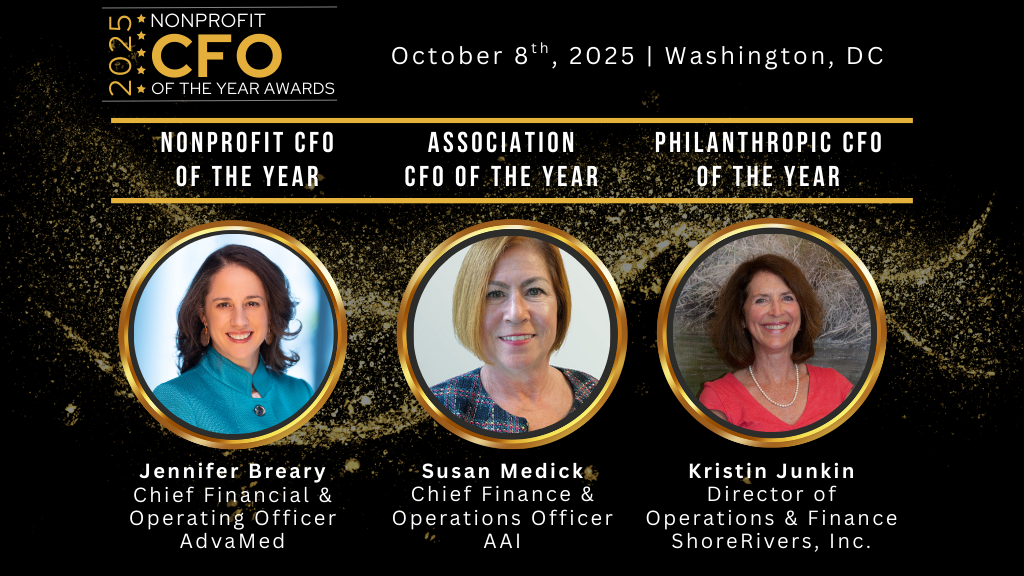
The path to becoming a nonprofit chief financial officer isn’t smooth or straight. And to succeed, it takes a lot more than education and experience as an accountant. What makes the 2025 Nonprofit CFOs of the Year so impactful? Being nimble, listening to members’ concerns and being willing to get involved in organizational initiatives beyond finance.
It’s been an uncertain and challenging time for nonprofit organizations, many of whose members are facing financial woes because of cuts in government grants and tariff policy. Those members look to leaders in nonprofit associations to help guide them, and the 2025 CFO honorees have done just that.
Brearey’s surprise ‘step forward’
For Jennifer Brearey, serving the financial interests of AdvaMed, the Advanced Medical Technology Association, means thinking outside the box.
Brearey, AdvaMed’s chief financial and operating officer and the 2025 Nonprofit CFO of the Year, received her bachelor’s in business administration from James Madison University in Virginia. That gave her a background not just in budget and accounting, but also human resources, facilities management and marketing.
With those skills, honed with earlier accounting stints at government agencies and for-profit companies, Brearey has helped AdvaMed lead its expanding membership through difficult times.
“I had the foundation, coming out of college, to be in a position to lead folks who are experts in those fields,” Brearey says.
Brearey spent seven years at Ford’s Premier Automotive Group division, where she held management roles in profit analysis and vehicle pricing for Jaguar and Land Rover North America. A certified public accountant, she also led accounting for the U.S. offices of a privately held intellectual property services firm, CPA Global. After being asked to take a trip to India while she had a four-month-old (she did it — pumping breast milk all the way), Brearey decided she needed a break.
She got a call from recruiter Joe Basile at Spectrum Careers in Vienna, Virginia, and was excited for an opportunity that would be “kind of my step back, to live life.” Before the interview with AdvaMed was even finished, they told her they expected the new hire to be quickly promoted.
“My ‘step back’ quickly became a step forward. It was a funny way to start,” says Brearey, who moved from director of finance to vice president of finance and then to senior VP/CFO before assuming her current role in 2021, overseeing a projected 2025 budget of about $56 million.
Brearey met the challenge of her new role by using her multilayered education and experience. A key goal was to make sure AdvaMed stayed relevant to its members, which include a wide range of medical technology companies, including members in Europe, India, China, Brazil and Japan.
AdvaMed advocates for high ethical standards and patients’ access to life-changing medical technologies. The organization also takes public positions on issues affecting its members, such as development of and access to vaccines.
During Brearey’s tenure, AdvaMed’s marketing team has created newsletters and posted relevant information to its website to inform members and attract new ones. Recently, medical technology companies have had to grapple with cuts in government funding for scientific ventures as well as tariffs. So, the association has promoted itself as the go-to source for critical industry news.
“We’ve had to stay relevant and add value to our members,” Brearey says. The result? “We’ve had one of our best retention years ever. We definitely had the best recruiting year in the history of AdvaMed this year,” she says, with dues from new members fueling an 8% growth in the budget.
AdvaMed’s 2024 conference hosted a record 4,350 attendees from 48 countries, with more than 400 speakers. It was “the biggest and most impactful in history” for the organization, AdvaMed states on its website.
Brearey has assumed other leadership roles as well. She recently served as chair of FAR (formerly the Finance & Administration Roundtable), a 300-member network of nonprofit executives. At AdvaMed, Brearey ran the Workforce Initiative, bringing in industry leaders across the country for conferences and publishing benchmarking studies to help members see how they compare with their peers.
Brearey also orchestrated a move to a new office with a layout that encourages collaboration by blending shared spaces with individual offices. “We had an office where you needed a map to get around. Now we’re in one big area and we’re running into each other more.”
Board meetings are held there, and Brearey believes the new office is why members drop by more often.
Her tip for having success as a CFO is to be nimble and responsive. “You can’t feel like you are stuck with a plan,” Brearey says. “You have to make sure that you are stuck with a solution.”
Junkin helps launch a nonprofit
What do you do when you have a law degree, stellar academic credentials, experience working with the government, a strong entrepreneurial record and a pilot’s license to boot?
In Kristin Junkin’s case, the answer was to save the environment on Maryland’s Eastern Shore. As director of operations and finance at ShoreRivers — and the Philanthropic CFO of the Year — Junkin has brought her rich professional background to advance ShoreRivers’ mission to protect Eastern Shore waterways through science-based advocacy, restoration, education and engagement.
“I’ve been fortunate in having quite a few different experiences that kind of meld, and came together to what I’m doing now,” says Junkin, who has held her position at ShoreRivers since 2009.
It’s been a multifaceted journey with several exciting stops. After graduating summa cum laude from Howard University (where she was elected Phi Beta Kappa), Junkin earned her law degree from the University of Virginia School of Law. She always had an interest in aviation law, she says, having acquired a pilot’s license. She practiced transportation law for a few years and even spent a year in Germany, teaching law at an American university campus there.
But Junkin’s entrepreneurial bent lured her away from legal work. She left a law firm to cofound a federal government contracting business in the 1980s. After about 12 years she bought out her two partners and sold the business to spend more time with her two children.
She then founded Outside Counsel, a temp firm that provided document review and other crunch-time legal services. Junkin ran it for about five years and then sold it to a national staffing company.
“Basically, my background was building small businesses and selling them,” she says. That skill would come in handy in her current role.
Junkin and her husband had moved to the Eastern Shore, and her husband wanted to start a nonprofit to protect and restore the area’s environment.
“He had the vision, and the passion for the vision,” Junkin says. “But he needed a lot of help on the operations side.”
With her legal and business background, including navigating the world of writing nonprofit grant proposals, Junkin stepped in to fill the business end of ShoreRivers.
“I had the government contracting background. I knew there was funding out there for all kinds of work,” says Junkin, adding that she was “pretty instrumental in building the grant portfolio over the years.”
The group has grown tremendously: It started with one employee and a $150,000 budget, and now has 32 employees, plus interns, and $9 million in revenue this year.
Like many nonprofits, ShoreRivers is facing grant cuts. About 75% of its funding comes from government sources, with the rest coming from foundations. Fortunately, Junkin says, more of the group’s government funding comes from state sources than federal.
“We did pretty well and we have enough diversity (of funding) in our work,” Junkin says. “We don’t have all our eggs in one basket.”
The most important thing for a nonprofit CFO is to build trust with stakeholders, providing accuracy and transparency to assure them the organization is using its money responsibly and completing projects on time and within the budget, Junkin says.
“These stakeholders have to not only support your mission, but they have to believe in us,” Junkin says. “We value and respect the (contribution) of every donor, (whether it’s) $10 or $2 million from a big agency,” Junkin says. “That’s an important part of the culture, of who we are.”
Medick keeps AAI current
Susan Medick is handling finances and fiscal strategy at a trying time for the American Association of Immunologists. In addition to funding cuts, a skeptical approach to vaccines in general has put pressure on AAI members.
But Medick, chief finance and operations officer of AAI and the Association CFO of the Year, has weathered the storm, updating the accounting and budgeting systems and facilitating financial planning and management.
“Right now, our biggest challenge is the unknown, with all these things coming out of the new administration,” says Medick, referring to cuts to scientific research and reductions in the public health workforce.
“We’re very lucky at AAI that we have a lot of nice reserves. We have a cushion — but we don’t want to go through all of that cushion,” she says. AAI employs 30 people and has an annual budget of $10 million.
“It really is looking at what programs have the best return on investment for our membership and the organization, getting into the discipline of reviewing the programs on a regular basis.”
Medick, a CPA, started out in public accounting after getting her bachelor’s in accounting from the University of Maryland. She went to work for the Auto Care Association and moved on to CFO positions with the International Association of Amusement Parks and Attractions, the Telecommunications Industry Association and the Association for Diagnostics & Laboratory Medicine before beginning her current role at AAI in 2023.
“When I decided to leave public accounting, associations and nonprofits were to me more interesting,” Medick says. “I love the fact that you get to learn about a different industry without necessarily working in that industry.”
Medick says she loves working for scientists, but she has zero science experience.
“I will tell you that every science teacher passed me because they did not want to see me back the following semester. Science is not my forte,” Medick says.
Financial management and a commitment to mission-driven enterprises is Medick’s forte. In the words of AAI’s CEO, Loretta Doan, within six months Medick “accomplished 20 years’ worth of modernization to AAI’s accounting and budgeting systems, streamlining staff’s work and establishing more secure financial tracking and transactions.”
Medick also worked hard to change the culture at AAI, making it “a very welcoming and positive” one. AAI never had a true HR function, Medick says, so they hired an HR director who has made a real difference there.
She also looked at how to protect AAI’s revenue stream. The group’s two biggest revenue generators are its annual meeting and its scientific journals. Under an agreement reached before Medick started her job, AAI moved to a publishing partnership with Oxford University Press, which she says has been financially beneficial. The partnership gives authors help promoting their articles, including free assistance in search engine optimization, as well as tools to help authors share their work with colleagues more easily. AAI still owns all the content, but the partnership reduces expenses, she says.
The annual meeting is another moneymaker, and it did well in 2025, with over 4,000 attendees (it helped that the meeting was in Hawaii, Medick quips). She does, however, have concerns for 2026. People had already booked travel and paid the fees for this year’s conference, so cuts to government scientific research grants had not yet hit the industry. Next year will be more of a challenge, as members feel budget crunches themselves.
“I think what helps, to be successful, is that you want to stay current, go to the networking events, stay on top of all the latest trends,” Medick says of her approach. And working as a team is essential. “Sometimes the best idea is to borrow someone else’s idea,” Medick says.
The 2025 Nonprofit CFO of the Year awards will be held Oct. 8 in Washington, D.C.