

Leading association lobbyists give voice to industry
Greg Crist, Jennifer Fox, Carl Holshouser and Jason Ortega recognized for successes in advocacy.
- December 11, 2024 |
-
 Melanie Kalmar
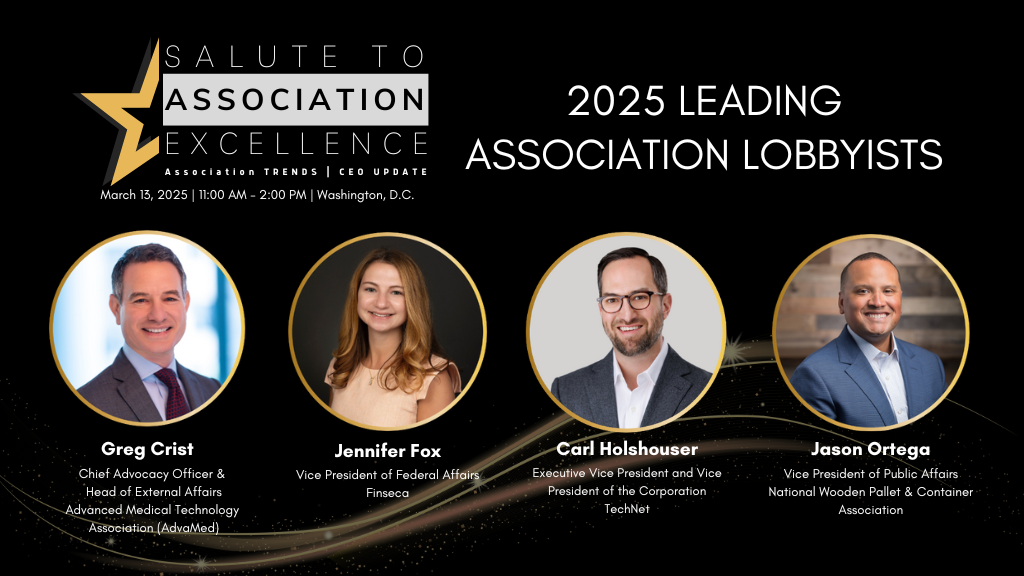
Behind every piece of legislation is the work of lobbyists who set out to educate policymakers on issues that impact Americans’ lives. For lobbyists Greg Crist, Jennifer Fox, Carl Holshouser and Jason Ortega, the process of helping legislators frame sound policy is just as thrilling as seeing it become law. This involves telling the story of an industry’s unique position in the marketplace, succinctly and with stellar data to make any argument indisputable. It’s a skill that takes years to perfect, and they have managed to do just that.
On March 13, 2025, Crist, Fox, Holshouser and Ortega will become part of the story when Association TRENDS and CEO Update honor them as leading lobbyists at the 2025 Salute to Association Excellence awards.
With humility and candor, they spoke to CEO Update about the early days of their careers and what it takes to be a changemaker on the Hill.
Making lives better
When Greg Crist graduated college in 1994, he took an unpaid fellowship with George Allen, the Republican governor of Virginia, while waiting for the job market to improve. Despite the absence of a paycheck, it turned out to be the right move. At 22, he became Allen’s personal aide and gained exposure to all facets of government and public affairs.
“After four years, I decided, ‘I want to do this at the federal level,’ and moved to D.C.,” recalled Crist, now chief advocacy officer and head of external affairs at the Advanced Medical Technology Association (AdvaMed).
After a quick stint at Ketchum Public Relations, he held various leadership roles on the House staff before entering the lobbyist world in 2005 with Dutko Worldwide. Later, he found his niche in health care at the American Health Care Association and ultimately, a passion for innovation at AdvaMed.
Crist joined AdvaMed in 2017 as senior vice president for public affairs and, a year later, assumed the chief advocacy role.
D.C.-based AdvaMed has more than 500 members—manufacturers of medical technologies responsible for upward of 190,000 classes of devices regulated by the Food and Drug Administration. From pacemakers to MRI machines, artificial hearts and continuous glucose monitors, it’s a $2 trillion industry, Crist said, and the U.S. is the global leader in exports.
“Medical technologies have added five years to the lifespan of an average American,” he said. “It’s a big reason why I love my job.”
His greatest challenge is working in a town with “a surplus of information and a deficit of attention.”
“A large part of what we do is basic education and awareness,” he said. “We continuously remind policymakers of the outsized role we play in health care delivery in this country.”
About a year into his job, AdvaMed was at the helm of an industrywide effort to repeal the 2019 Medical Device Tax. The legislation placed an excise tax on all medical innovations, Crist said, resulting in 77,000 jobs lost the first year.
“We saw a renaissance of innovation and greater investments because the tax was lifted in December 2019,” Crist said. Now he’s excited to watch AI usher in the next generation of innovations.
“Winning this award is the highlight of my career,” Crist said. “It’s recognition of the role that lobbyists and advocates play, and it might draw future leaders to the profession. And the more prepared the next generation of advocates is, the better our government will be.”
Planning for the future
During her senior year of college, Jennifer Fox maintained a full-time course load while working at the White House Office of Presidential Correspondence, reviewing all the mail President Barack Obama received.
“I saw that if you write to your lawmaker, you have a voice,” recalled Fox. “And I became interested in helping people find their voice, to utilize it to affect policy, and help make their lives better.”
After graduating in 2014, Fox advocated for restaurant owners and employees at the National Restaurant Association and tech startups at Engine Advocacy. But joining D.C.-based Finseca in 2019 changed her career trajectory by giving her the opportunity to grow and try new things. She quickly advanced from manager of political affairs to her current role, vice president of federal affairs.
“As a woman in this profession, where less than 40% of lobbyists are women, being highlighted as a top lobbyist is an honor,” she said.
The name Finseca represents “financial security for all,” which is the 10,000-plus member association’s mission. “Our members are financial security professionals,” Fox said. “They’re the people sitting across the table from families or small businesses, helping them create a financial plan for the things you hope for in life, like retirement or success in business. And the things you hope never happen, like early death or disability.”
Fox has been instrumental in shaping policies that protect the profession and financial security of Americans. She increased participation in the $20 million-revenue association’s Ambassador Program by more than 25%, giving members opportunities to get to know lawmakers and drive impact.
On the retirement side, Fox helped structure SECURE 1 and SECURE 2.0, bipartisan retirement bills to create more opportunities for consumers to save for retirement.
Recently, she joined forces with industry partners, attending upward of 300 meetings in about six months, to battle a Department of Labor regulation that would restrict many Americans’ access to financial advice from financial security professionals. After presenting research by Ernst & Young that determined permanent life insurance plus annuities (which are sold by financial security professionals) along with investment equals a better retirement than investments alone, she’s optimistic the outcome will be favorable.
Right now, she’s preparing for the “Super Bowl of Tax,” an abundance of tax code that sunsets at the end of 2025, with the same fervor.
“It’s easy to get stuck in your ways,” Fox admits. “Try something new, ask questions and be curious. That’s what helps me grow and keeps me active and interested in this work.”
Promoting innovation
Carl Holshouser, executive vice president and corporate officer at TechNet, caught the lobbyist bug after participating in a University of Texas at Austin fellowship program.
From 2005 to 2009, he was an aide and personal assistant to U.S. Sen. Kay Bailey Hutchison (R-Texas). The closeup view of policymaking and the role associations and interest groups play in advocating for members became the foundation for his life’s work.
Over a 20-year period, he had roles with major corporations and industry associations. But his career took an unexpected turn when he became a PwC consultant advising business and industry groups. In that role he created a five-year plan to take TechNet, an association of technology executives, to new heights. Then TechNet CEO Linda Moore recruited Holshouser to come aboard and execute it.
He joined the team in 2020, and promptly drew in 30-plus new members and increased revenues 350%. Holshouser oversees the TechNet D.C. office’s advocacy efforts on issues such as AI, privacy, digital trade, tax, antitrust, startups and the gig economy. He is also heavily involved in managing the association alongside Moore.
Before taking this role, Holshouser was aTechNet member. “I had a unique chance to see the strengths, opportunity and potential of TechNet,” he said. “It gave me an idea of how to make it ultra-valuable for members and achieve its objectives.”
TechNet members are a diverse group of businesses, from startups to iconic companies like Google and General Motors that represent over 4.5 million employees, Holshouser said. TechNet advances public policies and private sector initiatives at the federal, state and local levels to make sure the U.S. is the world leader in innovation.
“There’s an old saying, ‘If you’re not at the table, you’re what’s for dinner,’” Holshouser said. “We have to be at every table.”
TechNet helped pass the CHIPS and Science Act of 2022 to fund and create 11 regional tech hubs throughout America’s heartland. Semiconductors (“chips”) power everything from household appliances to automobiles and mobile devices. Recently, the association led an effort to reform the National Environmental Policy Act to ensure the timely construction of chip factories, helping the U.S. compete with, rather than rely on, foreign countries to manufacture semiconductors. TechNet also protected Americans from legal liability for third-party speech (comments) on social media platforms, by helping defeat policymakers’ spring 2024 effort to repeal Section 230 of the 1996 Communications Decency Act.
Currently, TechNet continues to grow its $25 million AI for America campaign to ensure AI policy provides safeguards for consumers but isn’t overregulated.
“I’m honored to receive the award,” Holshouser said. “But it belongs to our entire team. It’s an indication that our trade association is making a tangible impact on the tech economy.”
Bolstering small businesses
A decade ago, when Jason Ortega arrived in D.C., he wanted to become a policymaker on the Hill. But he ended up at boutique lobbying firm Lobbyit, often serving as lead lobbyist for more than a dozen associations. While assisting chief executives and their boards, he learned how associations operate and became interested in doing more policy, operations and business development work. And the association world seemed like the ideal place to do it.
Ortega entered that world in 2021, when he joined National Wooden Pallet & Container Association (NWPCA) in Arlington, Virginia, as vice president for public affairs. The $6 million annual revenue association has more than 850 members in 40 countries, who predominantly manufacture wooden pallets and crates. About 10% to 15% of members are suppliers of products and services to the sector. “The industry is over 95% recyclable,” Ortega said. “No other packaging material comes close.”
The wooden pallet field is an $11.5 billion American success story, Ortega said, responsible for more than 173,000 American jobs with mostly family-owned businesses in 50 states. Most of the issues Ortega tackles are small business- and manufacturing-related. He leads NWPCA’s advocacy efforts on the Hill and in Brussels, to protect the use of wooden pallets in international trade. “A posture of, ‘Let me help you be successful in your goal, in a way that is workable for my members,’ has helped us be successful in the work we do,” he said.
Ortega also spends a lot of time with members, learning about their challenges and developing projects through NWPCA’s Pallet Foundation to benefit them. A current project focuses on showing members how to access new markets with wood residuals and create additional revenue streams.
“When wooden pallets are no longer useful for carrying goods, they are recovered for mulch, biofuel, pellets and animal bedding, to name a few,” Ortega said. “Less than 5% of wooden pallets left at landfills are used to hold down other waste before it biodegrades.”
In 2022 and 2023, Ortega and his team partnered with the Manufacturing Institute on research on workforce challenges, such as a shortage of manual labor, and offered potential solutions, such as giving previously incarcerated people a chance. Already, his team has begun engaging Congress to secure key provisions of the Tax Cuts & Jobs Act of 2017 that could expire in 2025.
Ortega is grateful for the many mentors who gave him “a peek behind the curtain of what they did to be successful.” And for his mom, for teaching him the work ethic that made those mentors want to help him.
“Earning this recognition from my peers is extremely validating,” he said. “It’s a highlight of my career.”